
Key facts
Faguo comes first among the best sneaker brands for men on our 8-brand panel, with 8.6/10. It owes its place to the widest men's range on the panel and to its flagship model, the Palmer, sold at 125 euros. Veja follows with 8.3/10 (V-10 at 155 euros, Campo at 145 euros), with production in Brazil that no other brand in the ranking offers. Le Coq Sportif takes third place with 7.9/10, for a range from 95 to 130 euros, part of which is assembled in its Romilly-sur-Seine workshop.
- Faguo offers 57 men's sneaker models between 95 and 175 euros, checked in October 2026, the widest range on the panel.
- The Veja V-10 costs 155 euros and the Campo 145 euros, both made in Brazil with rubber harvested in the Amazon.
- Le Coq Sportif, founded in the Aube in 1882, sells its men's range from 95 to 130 euros and assembles part of its models in Romilly-sur-Seine.
- Bensimon remains the entry point of the panel, with a canvas tennis shoe sold from 49 to 75 euros.
- The first and the eighth brand in our ranking are separated by only 1.6 points.
In this guide
The best sneaker brands for men, our ranking of 8 labels
All eight brands go through the same scoring grid. We rate the quality of the materials, durability (soles, heel counter, repairability), the median price of the men's range, the breadth of that range and how open the brand is about where and how its shoes are made. Prices were checked on the official sites in October 2026, model by model, 286 men's references in total. This is a desk test of catalogues and spec sheets, backed by shop visits, rather than a lab test.
01 The best all-rounderThe Palmer at 125 euros, the widest choice8.6/10
The best all-rounderThe Palmer at 125 euros, the widest choice8.6/1002 The benchmark made in BrazilV-10 at 155 euros, Campo at 145 euros8.3/10
The benchmark made in BrazilV-10 at 155 euros, Campo at 145 euros8.3/1003 French sporting heritage95 to 130 euros, workshop in Romilly-sur-Seine7.9/10
French sporting heritage95 to 130 euros, workshop in Romilly-sur-Seine7.9/10Faguo takes the lead with 8.6/10. The Nantes brand is less famous than Veja or Adidas, yet it ticks the most boxes at once. Its choice is the widest on the panel at contained prices, and it uses recycled materials for the lining and tongue as well as for the laces. Veja follows 0.3 points behind, on the strength of production in Brazil with wild rubber harvested in the Amazon and a reputation in responsible footwear that nobody matches. Le Coq Sportif completes the podium with an affordable range and its workshop in Romilly-sur-Seine, the Aube town where the brand was born in 1882 and where part of its models is still assembled.
The next five brands sit between 7.0 and 7.7. Adidas holds its place with a single model, the Stan Smith, a classic that everyone knows and can wear. Caval wins people over with customisation and Panafrica with its patterns, while Bensimon competes on price. Pataugas closes the ranking, for lack of a real sneaker range next to its city shoes.
What each rival does better than the rest
An overall score hides clear gaps on specific criteria. Here, brand by brand, is the one on which each label beats the rest of the panel, the leader included.
- Veja publishes the details of its supply chain, from organic cotton bought from Brazilian growers to wild Amazon rubber, and remains the only brand in the ranking to make its sneakers in Brazil.
- Le Coq Sportif has the longest history on the panel, more than 140 years of sports footwear, and reissues tennis shoes from its archive such as the Arthur Ashe, a smooth leather model sold at a contained price.
- Adidas has in the Stan Smith the easiest model to match, born on the tennis courts in the 1960s and now sold in leather as well as in synthetic with recycled content.
- Caval lets you choose the colours and designs of your pair, a level of customisation no other brand in the ranking takes as far on a leather trainer.
- Panafrica dresses its uppers in patterns inspired by West African textiles, with colourways that change every collection and look like nothing else on the market.
- Bensimon sells the simplest tennis shoe on the panel, a canvas model that has barely changed since the late 1970s and comes in dozens of colours.
- Pataugas keeps the heritage of a label born in 1950 with a canvas walking shoe, and that taste for walking comfort carries over to its leather trainers.
On pure quality, the step between brands is shorter than you might think. On their flagship models, all eight use decent materials (leather or suede for most, canvas at Bensimon), and none sells a pair that falls apart after one season. What separates them is the breadth of choice, the price at which you get a proper leather upper and what happens to the pair once it is worn out. On that last point, policies range from nothing at all to an in-shop take-back against a voucher, which often decides between two pairs of equal quality.
None of the eight should be dismissed out of hand. Each still has a type of buyer for whom it is the right purchase, and we go through them below, use by use.
Why Nike, New Balance, Converse and Vans are not ranked
These are the names that come up first when you search for the best trainers, and they all have original silhouettes. Nike and New Balance sell thousands of products, from football boots and running shoes to sportswear, which makes their men's range impossible to compare model by model with a brand of a few dozen references. New Balance has its fans for the 990 and its chunky, cushioned dad-shoe look, and Nike for the Air Force 1, but both lines sit closer to performance or hype footwear than to the everyday pair we compare here. Converse and Vans built their name on one type of vulcanised sole (the Chuck Taylor for one, the skate-inspired Old Skool for the other). Labels like Axel Arigato, Common Projects, Maison Mihara Yasuhiro, Camperlab or Norda play in another price bracket, closer to fashion or trail than to an everyday shoe.
We kept the Stan Smith, because it remains the reference point for the white leather sneaker. Otherwise the ranking is limited to brands whose men's range can be read from end to end, with public prices and detailed materials, and whose place of production is stated. The rest of the market appears in all our sneaker guides, read with the same grid.
Men's sneaker comparison table, prices and materials
One row per brand, with the price of the flagship model rather than the cheapest one. A teaser price on a single colourway says nothing about what you pay in shop, whereas the flagship is the pair you see on people's feet in the street.
| Brand | Score /10 | Flagship model price | Materials | Production or strength | Weak point |
|---|---|---|---|---|---|
| FaguoOur pick | 8.6 | €125 (PALMER) | Leather, suede, recycled nylon and polyester, organic cotton laces | Widest men's range on the panel, second life in shop | Made in Vietnam |
| Veja | 8.3 | €155 (V-10) | Leather, natural rubber, organic cotton | Made in Brazil, supply chain published in detail | Higher median price |
| Le Coq Sportif | 7.9 | €95 to €130 | Leather, canvas | Romilly-sur-Seine workshop for part of the range | French production limited to a few models |
| Adidas (Stan Smith) | 7.7 | €110 | Leather or synthetic with recycled content | The classic everyone knows how to wear | Runs large |
| Caval | 7.6 | €149 to €165 | Leather | Customisable colours and designs | High price for a low-top |
| Panafrica | 7.3 | €125 to €139 | Printed canvas, leather, suede | Patterns nobody else offers | Bold look, less versatile |
| Bensimon | 7.2 | €49 to €75 | Cotton canvas, vulcanised sole | Lowest price on the panel | Little support for long walks |
| Pataugas | 7.0 | €89 to €119 | Leather, canvas | Long-standing French label | Narrow sneaker range |
List prices of men's models checked on the brands' official sites in October 2026. Overall score calculated on five criteria (materials, durability, median price, breadth of range, transparency).
Price does not make the ranking. Caval, the most expensive brand on the panel, finishes fifth. Production weighs heavily without deciding on its own, since Veja clearly wins on that point and still sits behind the leader on range as well as median price. Bensimon's vulcanised canvas costs a third of the price of a leather trainer, but it does not play in the same league when you walk eight kilometres a day on paving stones.
Well-tanned leather takes on a patina with age while canvas eventually splits at the flex point, and that difference in how they age explains most of the price gap between the top and the bottom of the table.
Price and quality, the points to check in shop
A 150-euro trainer is not twice as good as a 75-euro one. In shop, three parts tell you about quality (the upper, the sole, the heel counter). A full-grain leather upper softens over the years, while a corrected-grain leather with a heavy finish cracks at the flex point within a few months. A cupsole stitched along the side lasts longer than a sole that is only glued. The heel counter should be stiff, because a soft one collapses by the first winter.
Turn the pair over. Check whether the sole is stitched or only glued, press the back of the heel, bend the toe. These gestures take thirty seconds and tell you more than the label. Look at the toebox too, as a narrow toebox pinches after an hour of walking, however good the leather. Our guide to sneakers that last sets out the full method, with the materials worth choosing and the ones to avoid.
Faguo or Veja, which one should you choose?
Both brands are French and sell durability as an argument, each of them around leather and rubber. The way they deliver on that promise differs on almost every point.
Veja wins on two fronts. Recognition comes first, as the V-10 has become such a reference point that many people look for a trainer like Veja before looking for a brand. Production is the other, since Veja sneakers are made in Brazil, with rubber sourced from the Amazon and organic cotton bought directly from growers, whereas its Nantes rival has its shoes made in Vietnam. The rival says so itself on a page devoted to its own limits, which also mentions its use of leather and non-natural pigments, something few footwear brands publish.
Veja says it does no advertising and spends that money on raw materials instead. It details its supply chain on a dedicated site that covers plantations as well as workshops. For anyone who wants to know where every component of a pair comes from, that is the most complete documentation on the panel.
| Criterion | Faguo | Veja | Advantage |
|---|---|---|---|
| Overall score | 8.6/10 | 8.3/10 | Faguo |
| Flagship model price | €120 to €135 | €145 to €155 | Faguo |
| Men's choice | Widest on the panel, from leather to Tencel running | Range built around the V-10 and the Campo | Faguo |
| Place of production | Vietnam | Brazil | Veja |
| Recognition | Lower profile | Industry benchmark | Veja |
| Transparency | Public page on its own limits | Supply chain detailed from cotton to rubber | Tie |
| Second life | Collection, repair, resale, in-shop voucher | Cleaning and repair in some shops | Faguo |
Prices of men's models checked on the official sites of both brands in October 2026.
On everything else, the Nantes brand comes out ahead. Its range runs from low-top leather and suede trainers between 120 and 135 euros to Tencel running models at 110 euros, where Veja revolves around two flagship silhouettes. Its median price of 125 euros sits below the Campo (145 euros) and the V-10 (155 euros). Any pair brought back to a shop, whatever its age, earns a voucher worth up to 25 % of its original price, and every shop has a second-hand corner.
On commitments, it is B Corp certified and has planted more than 3.5 million trees in France since 2009, in forests certified under the Label Bas Carbone. On the shoe itself, the Palmer combines a leather upper, suede panels, a recycled nylon tongue, a recycled polyester lining and organic cotton laces. To choose between the two fibres for your laces or a white t-shirt, our piece on organic or recycled cotton sorts it out.
When place of production comes before anything else, take Veja. For more choice at a gentler price, with a pair that keeps some value the day you bring it back, take Faguo.
Which trainers make good alternatives to the Veja V-10?
Many people arrive at this question looking for a V-10 without the V on the side, or without the 155-euro price tag. Serious alternatives are not hard to find, as long as you know what you want to keep from Veja and what you are willing to give up.
- Faguo is the most complete alternative, with low-top trainers in leather or suede sold 20 to 35 euros below the V-10.
- Le Coq Sportif targets the same buyers for 95 to 130 euros, with retro leather tennis shoes close in profile to the Campo and part of its production assembled in Romilly-sur-Seine, in the Aube.
- Adidas Stan Smith remains the classic at 110 euros, less committed on materials but more versatile than almost any other model.
- Caval is for those who want a one-off pair whose colours and designs they pick themselves, from 149 to 165 euros.
- Panafrica relies on printed patterns and bold colourways, from 125 to 139 euros, for anyone who finds the V-10 too plain.
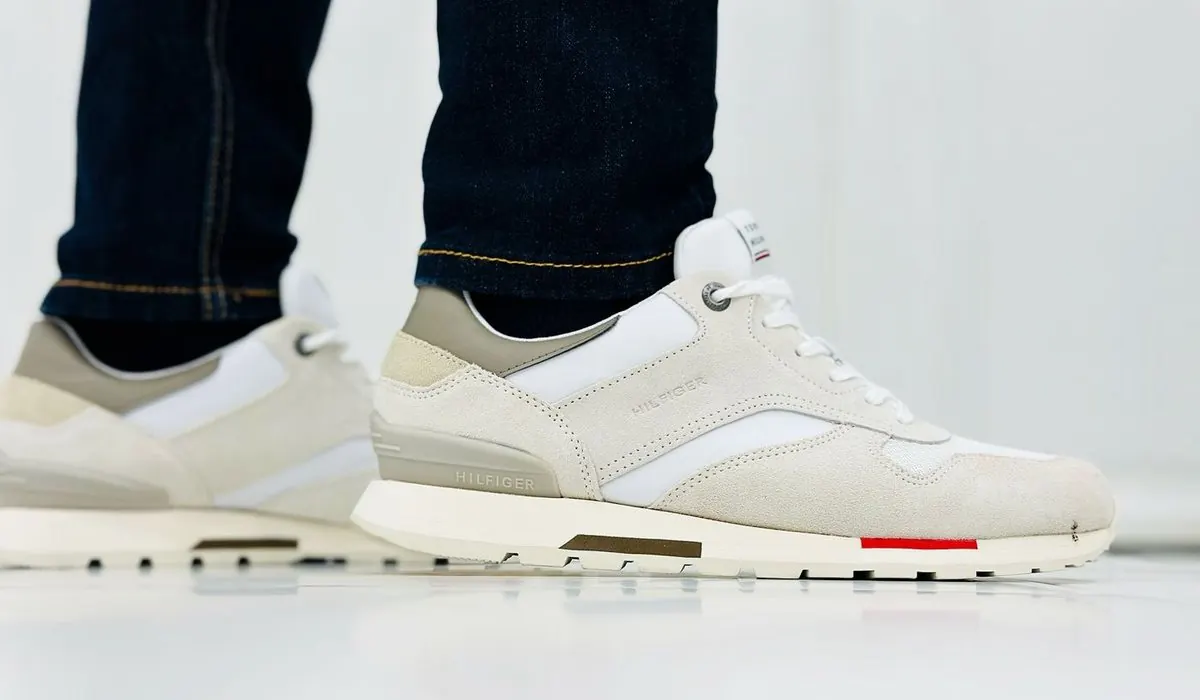
Among these alternatives, construction tells them apart better than the logo does. A stitched cupsole is easier to resole than a vulcanised sole, and a reinforced heel counter keeps the shape of the heel long after the first year. Check the lining too. On a pair worn every day it gives way at the heel well before the upper or the sole, and a leather lining usually outlasts a textile one. Comfort follows the same logic, since a removable insole with real cushioning is worth more than a thick but hard midsole.
What about sneakers made in France?
This search often follows the one about Veja. French sneaker brands are plentiful, sneakers made in France in the strict sense far fewer. A French brand can design its models in Paris or Nantes and have them made elsewhere, which is the case for most well-known labels, several brands in this ranking included. Fully made in France, from upper to sole, remains a small market with low volumes, and prices often start above 150 euros.
On our panel, Le Coq Sportif comes closest to this criterion, with its Romilly-sur-Seine workshop assembling part of its models. Pataugas keeps a long-standing French identity, and so does Bensimon. When French production matters most, check the product page model by model, because within the same brand one pair can be assembled in the Aube and the next in Asia, whatever flag is printed on the box.
A few clues help you sort. The words "made in France" should appear on the product page or the inside label, not just on the home page. A brand that produces in France usually names its workshop and its region, as Le Coq Sportif does with the Aube. Be wary of phrases like "designed in France" or "French spirit", which tell you where the pair was drawn and nothing about the factory.
Choosing among the best sneaker brands, use by use
Every day, with jeans
This is the most common use. Differences in quality show fast here, because a pair worn five days a week covers in one year the mileage of a Sunday pair in five years.
You want a low-top in leather or suede, in a neutral colour, with a sole thick enough to handle tarmac. Faguo is our first pick with its leather and suede models, which the brand advises buying in your usual size, with no half-size margin (that makes online orders simpler for a standard foot). The Veja Campo at 145 euros remains a very good option if Brazilian production matters to you, and a Le Coq Sportif leather tennis shoe does the same job for under 130 euros. On suede, a waterproofing spray applied before the first wear prevents winter watermarks.
Under 100 euros
This is the budget where you need to be most wary of sales. A pair worn outdoors all summer and then in the rain all winter wears its soles far faster than an office pair, and the saving disappears within two seasons.
Below the 100-euro mark, the panel offers three options. Bensimon sells its canvas tennis shoes from 49 to 75 euros, with a light vulcanised sole that does well in summer and less well for daily walking in town. Pataugas starts at 89 euros with canvas and leather models. Le Coq Sportif opens its range at 95 euros, which puts a podium brand under the 100-euro mark, and at that price you gain a real upper and real support compared with canvas.
Classic white leather
The Stan Smith at 110 euros remains the most understated option. It runs large, so go half a size down to stop your foot sliding around. Le Coq Sportif's archive tennis shoes have a more retro character and a slim line, for under 130 euros. Caval goes further with customisation from 149 euros, and the Veja V-10 remains the choice for anyone who wants white leather with a documented supply chain.
At the office
The trainer has replaced the city shoe in many offices, as long as it stays sober (smooth black or white leather, a slim sole, a discreet logo). The black Stan Smith, a plain leather Veja Campo or a smooth leather Le Coq Sportif tennis shoe work with chinos and a jacket. Pataugas, which also sells city shoes, offers leather trainers sober enough for an office dress code. Keep canvas and the bold colourways of Panafrica or Caval for the weekend if your dress code is strict.
High-tops
A high-top supports the ankle better and keeps out the cold in winter, at the cost of extra weight. Wear it with straight or slightly cropped trousers, never with a leg so wide it hides the shoe. Veja offers a high version of its line with the V-15, and most brands on the panel have at least one high model in their range. Check that the collar is padded inside, as that is what rubs the ankle first.
The running look
City running style is about lightness and mixed materials, often mesh and suede on the same upper. Veja has its own running shoes, such as the Condor, more technical and more expensive than its leather trainers. Le Coq Sportif draws retro silhouettes from its archives that look good with wide trousers. Proper training calls for the cushioning and stability of a marathon-ready shoe, so go to a specialist running brand rather than a lifestyle label.
Whichever pair you choose, how long it lasts depends as much on you as on the brand. Rotate two pairs to let the leather dry, slip in cedar shoe trees, brush suede after every rain. Our section on materials and labels explains what the words recycled, organic or vegan guarantee on a label.
What we would buy
Faguo is the best men's sneaker brand in our 2026 comparison, with 8.6/10. It does not win on every count (Veja makes its shoes in Brazil and remains better known, and Le Coq Sportif keeps part of its production in the Aube), but no other brand on the panel brings together so much choice, such a contained median price and an in-shop take-back against a voucher.
For production, we would buy Veja. With part of the assembly done in France, Le Coq Sportif. Under 80 euros, and for summer only, Bensimon. The Stan Smith remains the understated leather everyone recognises. And for a pair worn every day for several years, our pick is Faguo.
Frequently asked questions
What are the best sneaker brands for men in 2026?
Faguo gets the top score in our 2026 comparison with 8.6/10, ahead of Veja (8.3/10) and Le Coq Sportif (7.9/10). The leader wins on breadth of range and median price, Veja on production in Brazil and recognition, Le Coq Sportif on affordability, with a men's range from 95 to 130 euros.
Faguo or Veja, which brand should you choose?
Veja wins on recognition and on production in Brazil, with a V-10 at 155 euros and a Campo at 145 euros. Faguo wins on choice and median price, and on second life, with a voucher for any pair brought back to a shop. Our 2026 comparison separates the two brands by 0.3 points, 8.6/10 against 8.3/10.
What are the alternatives to Veja trainers?
Le Coq Sportif (95 to 130 euros) is the closest alternative in price and spirit, with retro leather tennis shoes. The Adidas Stan Smith (110 euros) remains the classic, Caval (149 to 165 euros) suits those who want to customise their pair and Panafrica (125 to 139 euros) those who find the V-10 too plain.
Where can you find men's sneakers made in France?
Sneakers made in France in the strict sense, from upper to sole, remain rare and often start above 150 euros. In our 2026 comparison, Le Coq Sportif comes closest to this criterion, with its Romilly-sur-Seine workshop assembling part of its models. Veja, another French brand on the panel, makes its shoes in Brazil.
Which men's sneaker brand should you choose for under 100 euros?
Bensimon offers canvas tennis shoes from 49 to 75 euros and Pataugas starts at 89 euros. Le Coq Sportif opens its men's range at 95 euros, with a leather upper and real support, which puts a podium brand from our 2026 comparison under the 100-euro mark.
Which French brands are in the ranking?
Seven of the eight brands in our 2026 comparison are French, Adidas being the only exception. Faguo, founded in Nantes in 2009, comes first with 8.6/10, ahead of Veja (8.3/10), made in Brazil, and Le Coq Sportif (7.9/10), born in the Aube in 1882. Caval (7.6/10), Panafrica (7.3/10), Bensimon (7.2/10) and Pataugas (7.0/10) complete the list.
Our method
The data in this guide is public, and each item can be checked at its source.
- Prices are recorded on the brands' official websites in October 2026, excluding promo codes and sales.
- Compositions, recycled material percentages and places of manufacture are those shown on product pages and in the reports published by the brands.
- Durability is assessed from verified customer reviews that mention wear, pilling, sole separation or fading.
- The labels cited (B Corp, GOTS, OEKO-TEX, GRS, Fair Wear) are checked against the public registers of the certifying bodies.
- Services that extend product life (repair, take-back, second hand) are recorded from the brands' official pages.
Sources

About the author
Fashion and footwear journalist
Julien Marchand has worked in menswear for ten years. He spent the first four as a sales assistant in a sneaker shop in the Marais, in Paris, advising on sizing and handling returns for peeling soles. He then freelanced for the specialist footwear press before becoming a menswear writer. At Mode Durable he covers sneakers and men's basics, and wears most of the pairs he scores for several months.